
Returning pests usually mean there’s something to check before you buy a stronger spray: hidden survivors, a life stage the treatment missed, a product that doesn’t target the pest, or another plant bringing pests back. Sometimes you’re seeing old damage, not returning pests at all. I’d start by looking for live activity. Fewer pests immediately after spraying is encouraging, but it doesn’t mean every one is gone.
If you find live pests, separate the plant from your collection and inspect its neighbors without automatically spraying them too. You’re trying to find what the last treatment missed, not give every plant another dose just in case.
First, look for something alive
Scarred leaves don’t heal when pests die. Thrips damage is especially misleading: feeding on folded or developing tissue can become obvious only as that tissue expands. A newly opened, scarred leaf therefore isn’t proof that feeding happened after treatment. Pair damage tracking with a search for live pests.
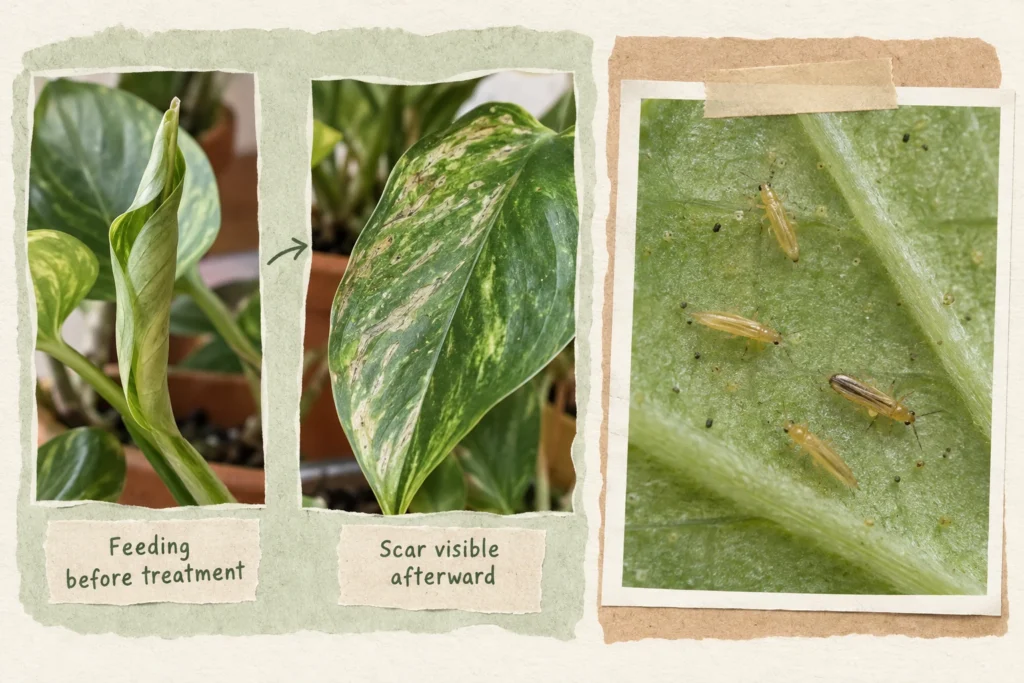
Imagine I’m turning a pothos toward the window and a pale scar appears on an unfolding leaf. The spray bottle is behind three pots; I’m already annoyed at having to move them again. But instead of spraying, I photograph the scar and inspect the folded growth and leaf undersides with a magnifier. I want evidence of a pest, not another application prompted by the same old injury.
Look on new growth and check the upper and lower surfaces of the leaves as well as stem joints. Pests such as spider mites are difficult to see with the naked eye. They are easier to see with the aid of a microscope or low power lens. Tapping leaves over a sheet of white paper will help you see them better. Sticky traps tell you nothing about larvae. An empty sticky trap is little solace if you are looking to control the flying adult fungus gnats.
The spray may have worked exactly where it landed
Insecticidal soap is designed to kill pests by contact and does not leave a residue. It cannot kill pests that arrive after the soil has dried. Coverage is the problem, not that you mixed it too weakly. Increasing the concentration will not kill a colony that is hiding in a secret location.
| What you notice | What may have been missed | The useful check |
|---|---|---|
| Mealybugs return in stem joints | Protected feeding sites and wax can reduce contact-treatment effectiveness. | Look inside leaf axils and other crevices, not just across exposed leaves. |
| Thrips appear after visible adults disappear | Eggs may be protected within plant tissue; pupation sites vary by species. | Inspect developing growth and identify the thrips before assuming the soil needs treatment. |
| Fungus gnats still fly after a larval treatment | Bacillus thuringiensis israelensis, or Bti, targets larvae rather than existing adults. | Track adult catches over time and check whether the treatment actually targeted the potting mix. |
| Spider mites remain after a systemic insecticide | The active ingredient may not control mites; imidacloprid does not. | Check the named pest and active ingredient rather than relying on “systemic.” |
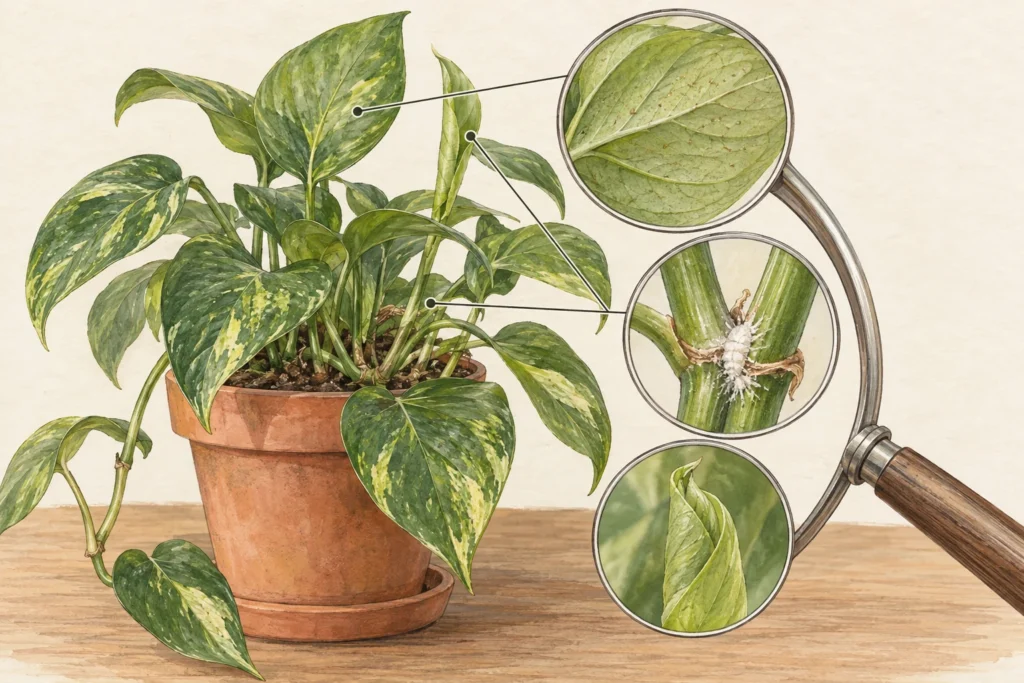
This is why I would not take "the spray failed" or "sprays never kill eggs" as the only reason as an explanation for treatment failure. There are many reasons treatments fail. For example, thrips are protected by the tissue where they are developing and will not be affected by contact sprays. Mealybugs are protected by a wax covering where they will not be contact by spray treatments. Younger pests are generally more susceptible to treatment than more developed pests.
Another application of contact sprays will likely kill the next generation of pests, but only if the product label is followed. I have only been treating the plant for the pests that someone else has indicated are present and according to someone else’s schedule. This may explain why it is taking so long to rid the plant of the pests.
Did they survive, or come back from somewhere else?
Survival becomes more likely when new signs of pests turn up after each treatment. More signs after a new plant shipment, a plant returning from outdoors, or infested leaves coming in contact with a neighboring plant raises the probability of a reintroduction.
I’d use history to find where to search next, not to solve the mystery. It can happen simultaneously. The pattern can’t prove which plant spread the infection.
Plants contacting each other through foliage can be infected, especially through mites. Mites can be transmitted by sharing equipment and touching, which is a good reason to clean tools between plants and to not use a used, leaf-cleaning cloth. Thrips can fly, and according to UC IPM, fine screening is the only way to fully exclude thrips from greenhouses, so household screen can't totally exclude thrips. Because of all of this, I’d look at the neighboring plants before blaming the window.
What the bottle actually promises
The big words on the front aren’t enough to choose the next treatment. “Neem” can describe growth-disrupting ingredients or clarified hydrophobic neem oil, which work differently. “Systemic” describes movement within the plant, not control of every pest. Look for the active ingredient, formulation, named pest, and application site. Similar packaging doesn’t make a foliar spray and a soil treatment interchangeable.
Your container must allow for indoor use and treatment of the pest. If the label only allows for outdoor use, then it should not be used for indoor spraying. Indoor spraying may result in unlabeled residue that could harm people. The application and treatment directions should be followed. Extra spraying to increase treatment will not help solve an infestation. Other things like plant exclusions, sensitivity-test instructions and heat/light restrictions should also be followed. If the plant was excluded or shows possible spray injury, do not continue treatment. Additional treatment may cause further injury to the plant and may not even solve the infestation.
Determine the repeat interval and check how many applications you have made. Safer 5118 indoor soap, for example, gives different repeat directions for aphids and other pests. For other pests, up to three applications are allowed and other plant restrictions exist. These are repeat instructions for one product and not for all insecticidal soaps. Your container labeling controls. At the application limit, assess the treatment gap and pest and reconsider.
Be sure to arrange protective equipment and provide the ventilation required on the label before you apply the product. Keep children and pets away from the treated area before, during, and after application. Make sure you read and adhere to the restrictions for the product. If you cannot adhere to the restrictions, do not treat the plant and keep the plant away from other plants. You should also not increase the dose or use a different product. A “natural” label does not remove the risk of household exposure. Also using the product may still cause injury to the plant.
What would justify another treatment?
I’d keep a small record rather than rely on how the plant looks from across the room: the date, product and application, live pests and their locations, plus a photo. Compare the same sample each time, for example, three marked leaves, two stem joints, and the nearest neighboring plant. This isn’t an eradication test; it keeps a thorough search today from looking worse than a quick glance yesterday.
If you find a persistent population of mealybugs in one of the protected plant joints and you find improved populations on exposed leaves, then you should check connected plants to see if you are missing coverage. Usually, a downward trend in live mealybugs is an improvement. Continue monitoring. You may need to treat again if there is still pest pressure, the plant is still tolerating the mealybugs, and you are still within label restrictions. Spreading and unchanged activity requires better assessment of coverage and identification, and nearby sources should not be ruled out. Just because you don’t see mealybugs once does not mean they are not still there.
If correctly targeted, label-compliant treatment still fails, resistance is possible, but recurrence alone can’t diagnose it. Clear close-up photographs or a specimen submitted to an extension identification service can help resolve an uncertain pest ID before you choose another product. For a heavily infested plant, discarding it is also reasonable. I’d rather you protect the collection than feel obliged to keep spraying a plant you no longer want to rescue.
Sources and references
- University of Minnesota Extension: Managing insects on indoor plants
- UC Statewide IPM Program: Thrips (2014-05)
- UC Statewide IPM Program: Mealybugs (2016-03)
- Colorado State University Extension: Managing Houseplant Pests (2025-05)
- Safer Brand: Safer Brand Insect Killing Soap 16 fl. oz. concentrate instructions, linked from model 5118-6
- US Environmental Protection Agency: Do's and Don'ts of Pest Control (2026-05-05)
- US Environmental Protection Agency: Ten Tips to Protect Children from Pesticides and Lead Poisoning
- UC Statewide IPM Program: Thrips: Floriculture and Ornamental Nurseries