
Not automatically. If your houseplant keeps making healthy growth under adequate light, it may still benefit from fertilizer in winter. I'd reduce feeding when growth slows, rather than when the calendar changes, but first consider the nutrients provided by the mix or an earlier application. One emerging leaf isn't a request for a feeding. This advice is for common foliage houseplants in a potting mix, not plants in a nutrient solution, or plants that are in a defined rest period.[1][2][5]
Winter is a clue, not a feeding ban
The typical advice for winter feeding is to stop feeding because of shorter days, and less light, which leads to slower plant growth. That is a reasonable shortcut for a lot of plants grown on a windowsill, but I wouldn't let that shortcut be the rule for your house. Effective grow lights can support plant growth, and a warm living room by itself cannot.[1][2]
That was supported by a one-year experiment with an Umbrella Tree and Dieffenbachia. Increasing fertilizer did not help plant growth at 0.5 klx of light, but it did help growth at 2.0 klx. The plants were grown with cool-white fluorescent lamps, and those numbers are not household or target lighting levels, and are not a good indicator of setting your home light levels, but you can learn from the study that more fertilizer did not help the plants under dim lighting conditions.[4]
Look beyond the newest leaf
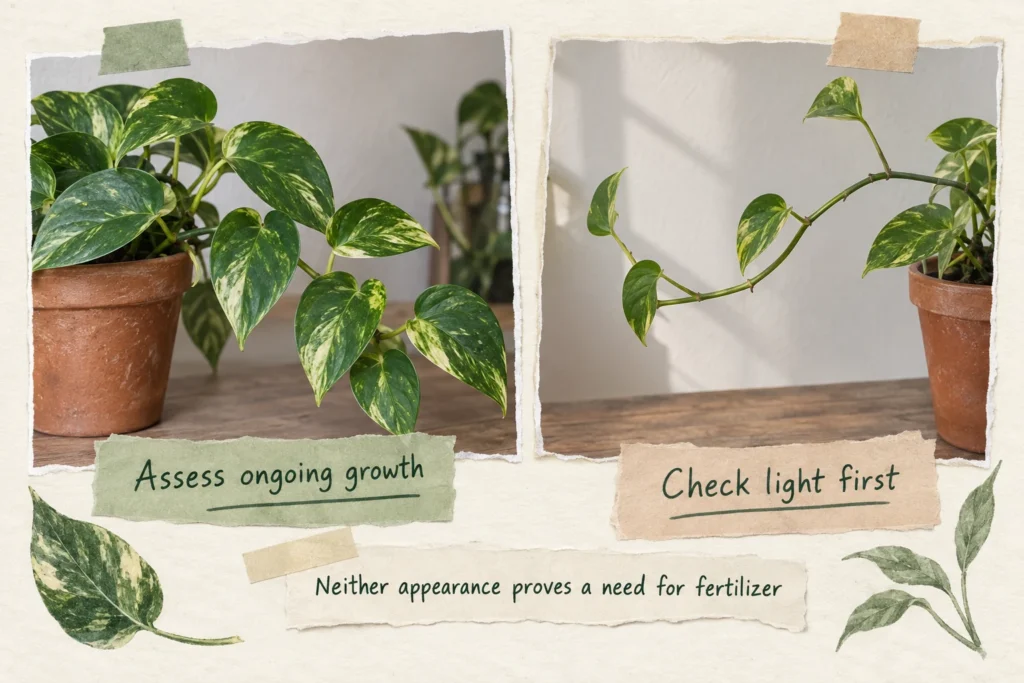
New growth is promising. What I’m interested in is the subsequent development: does growth continue in a similar fashion to how this plant grew previously? Long, thin gaps between the leaves would push me more towards looking at lighting, not fertilizer.[3]
You don’t need to count out the exact number of leaves. If growth is normal, then it’s activity, not the nutrient status of the growing medium, and discoloration doesn’t always mean deficiency. There can be other factors as well, for example, problems with the roots, adequate watering, and normal aging.[1][3]
Your pot may already be feeding the plant
To be sure, check the label on your growing medium and when you last fed. Some growing mediums contain fertilizer, and the manufacturer wording can often be confusing. For example, the Miracle-Gro Indoor Potting Mix for All Plants says to feed every 30 days but also states that after the first feeding, you can go 6 months without feeding. I certainly would not read that to mean your plant needs to be fed again or that the plant can go 6 months without feeding.[5]
Putting away the liquid feed doesn’t always mean that nutrients aren’t being supplied. Controlled-release granules can take a while to break down, and other factors can play a role as well. For example, in a dimly lit room, the demand for growth may not be there, but the granules may still be releasing nutrients.[6]
Imagine I'm beside a pothos in January, fertilizer bottle in hand, trying to decipher the crumpled potting-mix bag. Successive leaves look normal under unchanged grow lighting, and I'm pleased enough to want to help. Then I notice the mix already contains fertilizer and was added recently. I put the bottle away. The growth is credible; the need for another nutrient source isn't.
Continue, reduce, or wait
Continuous normal growth under appropriate lighting means that winter is not a reason to not add a nutrient. When growth starts to slow, space applications of the nutrient or decrease the dose per the product instructions is preferable to stopping applications all together. Some indoor fertilizer labels give different recommended concentrations based on frequency. I’d rather follow that distinction than make a “half strength in winter” rule.[1][2]
If your plant is healthy but its feeding history is unknown, I'd wait rather than stack another product on top. The same applies when existing fertilizer may already cover its needs or one isolated leaf is your only evidence of activity. If growth is stretching, check the light before feeding; if the plant wilts despite wet mix, pause fertilizer and investigate watering and root trouble. Neither problem is a reason to reach for more nutrients.[1][3]
Also notice whether the pot is taking longer to dry. When nutrient uptake slows and less water drains through the pot, an unchanged feeding routine can leave more salts behind; excess salts interfere with water uptake and can injure roots. Fewer waterings alone don't prove buildup, and crusting or leaf-tip damage isn't conclusive either. But if those signs appear or worsen alongside repeated feeding, pause fertilizer, check whether water can leave through the drainage holes, and review the amounts and products you've added. Don't water early just to deliver a dose.[1][3]
Sources and references
- University of Connecticut Home Garden Education Office: Houseplant Fertilization (2016)
- University of Maryland Extension: Fertilizer for Indoor Plants (2023-03-10)
- University of Minnesota Extension: Spring houseplant care
- C. A. Conover and R. T. Poole; Journal of the American Society for Horticultural Science: Influence of Light and Fertilizer Levels and Fertilizer Sources on Foliage Plants Maintained under Interior Environments for One Year (1981-09)
- ScottsMiracle-Gro: Miracle-Gro Indoor Potting Mix for All Plants
- ICL Growing Solutions: Controlled Release Fertilizers