
I generally don’t move a plant from a dim corner to direct sun. First, you want to make sure you give a plant the right kind of light to begin with, and only then ease the plant into different conditions. For many foliage plants, the right condition is brighter light as opposed to strong, direct light. Gradually increasing exposure to more light is a good way to condition a plant to a change in environment.[1][2]
Choose the destination before planning the move
A jade plant is okay to have in a window that gives direct, indoor, sun; a calathea is not, and a moth orchid also is not and is okay to have in a window that gives indirect, but bright, light. Before you pick the window to house your plant, you should identify the plant. These plants need different destinations, not just differences in how they get used to the same location.[2][3]
Even plant leaves that are okay to have in direct, indoor, sun can have leaves that aren’t used to it. A leaf can adapt to how it handles sunlight, but that may not be the case for a leaf that is developing. Thin, soft, foliage doesn’t necessarily mean that plant can handle more, direct, light.[1][2]
Look at the leaves, not just the window direction
Although not as strong as direct outdoor sunlight, clear glass lets in some direct light, which can still be harmful to plants. Indirect light means there is no direct beam of light hitting the leaves. To check if your plant will receive adequate light in that location, you have to observe when the beam comes through and how long it stays. It may also reach other leaves that it shouldn’t.[4]
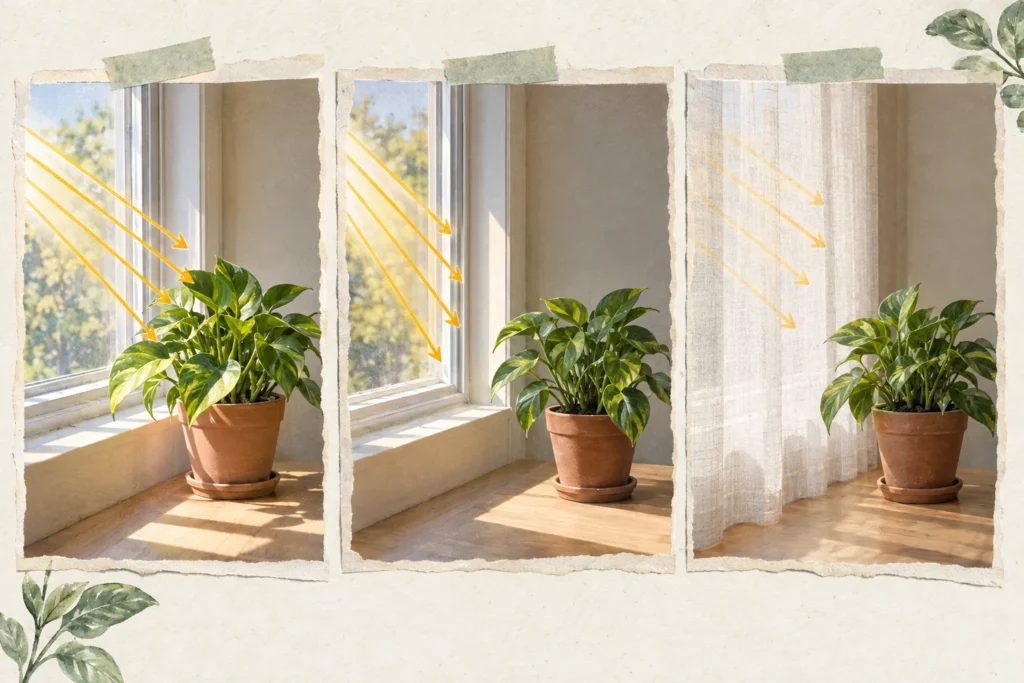
Imagine I’m moving a lanky plant toward the living-room window, pleased to have squeezed its pot beside the chair. Then an afternoon beam hits the leaves. Not the perfect spot after all. Rather than haul it all the way back to the dim corner, I slide it over to the beam, making sure to keep the window as a barrier from the direct sunlight.
Typically, the direction of the window tells you little about light exposure. Buildings and trees close to the house can block or shield the sun, making the exposure change throughout the year. In the U.S., the lower winter sun can reach father into a house than the summer sun, so moving a plant back from the window may not actually take it out of the sun.[4][5]
Glazing labels don’t always provide accurate information either. Strong sun combined with heat can damage the leaves. A beams feels warm to the touch, reduce exposure. But, just because a spot feels cool to the touch doesn’t mean it’s safe for the plant. You can’t always rely on your judgement to determine the actual temperature of the leaves.[6][7]
Change the exposure without making moving a daily chore
Position your plant near the window with the most support (maybe use a sheer curtain if there is foliage blocking light). If the plant is happy there, that could be its final destination.[2][4][7]
You want to slowly acclimate the plant to direct light, because there are no supported universal schedules for residential windows.
For the plant that prefers direct light, don't make too many changes at once. You can try exposing it to more gentle morning light, for example, and work your way up to a more intense light. You can always keep the plant steady and observe what happens to it between your changes. If you see bleaching or scorch marks, reduce exposure, and don't be disappointed if that means no more exposure for a while.[1][2][4][7]
It's possible the potting soil is dried out, making scorch marks even worse, so check on the soil moisture and reduce exposure if it is already dry. Adding water to a saturated soil won't help, and can make the condition even worse.[7]
Watch for new injury, not disappearing scars
Shading can leave leaves with faded or bleached areas which later turn brown and brittle. If you’ve reduced light exposure, you can take a photograph of the affected leaves as a reference. Don’t get depressed if an old pale scar turns brown. Focus on if new, healthy cells are producing new scars. Pay attention to the location of new scars, not their color.[7][8]
The old scars won’t turn green again. That doesn’t mean you need to cut off every untidy leaf: its remaining green tissue can still photosynthesize. I’d keep adequate brightness with less harsh exposure and look for additional injury to stop, then watch whether subsequent growth develops without damage.[8]
If damage keeps appearing away from the exposed areas after you reduce the light, I’d stop chasing a better windowsill. Brown margins alone don’t prove sun scorch. Check moisture, roots and pests before another move; otherwise you may keep adjusting the light for a problem it didn’t cause.
Sources and references
- Biochemical Society / Portland Press: Photosynthetic acclimation to changing environments (2023-04-26)
- Royal Horticultural Society: Best houseplants for sunny rooms
- Missouri Botanical Garden: How do I care for my jade plant?
- University of Florida IFAS: Light for Houseplants
- University of Georgia Cooperative Extension: Growing Indoor Plants with Success
- US Department of Energy: Window Types and Technologies
- University of Maryland Extension: Excess Light on Indoor Plants (2023-03-13)
- South Dakota State University Extension: Leaf Scorch and Sunscald in the Garden