
Tropical houseplants usually do not struggle indoors because you forgot to mist them one morning. They struggle because the room is drier than the plant can comfortably handle, and the owner responds by watering more instead of measuring relative humidity. Penn State notes that indoor relative humidity can easily fall below 30% during the winter heating season, and Clemson says hot, dry air is one cause of brown leaf tips and margins. (extension.psu.edu)
- Start with a hygrometer, not a spray bottle. EPA says indoor relative humidity should stay below 60%, ideally between 30% and 50% for the home, and humidity meters are inexpensive. (epa.gov)
- For a mixed shelf of tropical foliage, about 45% to 55% RH is a practical compromise. That target is an editorial inference from EPA home-moisture guidance and extension sources saying many houseplants do well around 50%, while some need more. (epa.gov)
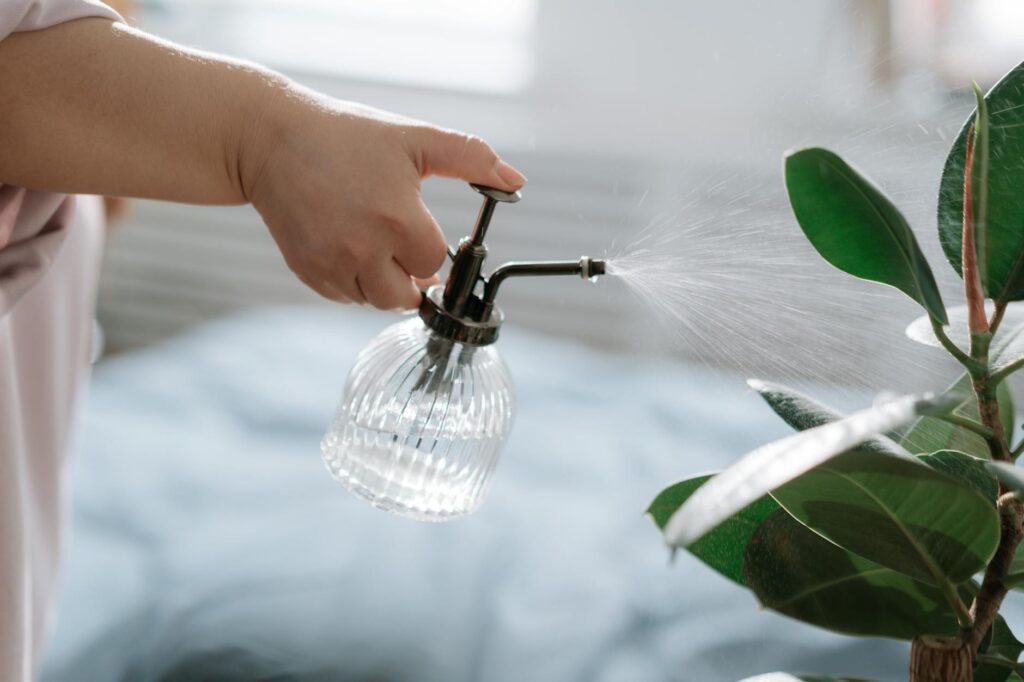
- Misting is not a reliable humidity fix. Penn State says the humidity bump lasts only until the water evaporates, and UMN says misting ferns is not very effective and can raise foliar disease risk. (extension.psu.edu)
- If your room sits around 30% to 35% RH for much of winter, either create a localized humid zone for finicky plants or choose tougher species such as Chinese evergreen. (hgic.clemson.edu)
The actual mistake: treating humidity like a leaf-care chore instead of a room condition
The expensive mistake is guessing. Owners see crisp edges, curled leaves, or stalled growth, assume the plant is thirsty, and keep the potting mix wetter than necessary while the air stays dry. That often creates a second problem: overwatering. Penn State says daily misting does not meaningfully raise humidity for long, and Clemson notes that overwatering is a major contributor to houseplant decline. (extension.psu.edu)
A better framing is simple: humidity is not something you do to a leaf for 10 seconds. It is a measured condition in the air around the plant, across most of the day. If you do not know the room’s RH, you are troubleshooting blind. (epa.gov)
Use the RH-First Reset scorecard
| Signal | Points | Why it matters |
|---|---|---|
| Room RH is below 35% for much of the day | 3 | That is well below what many tropical foliage plants prefer. (extension.psu.edu) |
| Plant sits within about 3 feet of a heat vent, AC vent, or drafty winter window | 2 | Hot or cold moving air can dry leaves and damage plant cells. (missouribotanicalgarden.org) |
| Plant is a fern, calathea, fittonia, or another humidity-hungry tropical | 2 | These are less forgiving than tougher plants such as Aglaonema. (extension.umn.edu) |
| You mist often but have not measured RH | 1 | Misting changes humidity only briefly. (extension.psu.edu) |
| Brown tips or crisp edges keep appearing even when the mix is still damp | 2 | That pattern can point to dry air, heat exposure, or salts rather than simple thirst. (hgic.clemson.edu) |
How to interpret score: A score of zero to three suggests that humidity is not likely the main issue. A score of four or five suggests that humidity is likely a contributing factor to plant problems. A score of six or above indicates that you need to address any humidity issues before buying fertilizer, repotting, or watering any more than you already do. This rule is meant to give you an editorial decision-making tool only, rather than a botanical rule, but it can be used to help stop you from wasting your time and/or money on incorrect solutions.
What humidity actually works in a normal home
There is a useful tension here. EPA advises keeping indoor RH below 60%, ideally 30% to 50%, to reduce moisture problems in the home. Missouri Botanical Garden says most houseplants grow well around 50% RH, while some need 70% to 80%. Put together, that suggests a practical target of about 45% to 55% RH for a mixed shelf of tropical foliage in an ordinary room. That 45% to 55% range is an inference from the sources, not a universal rule for every species. (epa.gov)
| Plant group | At 30% to 35% RH | At 40% to 50% RH | Best low-effort move |
|---|---|---|---|
| Chinese evergreen (Aglaonema) | Usually manageable. Clemson says it tolerates low humidity, dry air, and air-conditioning. (hgic.clemson.edu) | Comfortable for most homes. (hgic.clemson.edu) | Choose this type if your home stays dry and you do not want a dedicated humidity setup. (hgic.clemson.edu) |
| Pothos | Often survives, but Clemson says it prefers 50% to 70% RH and low humidity can contribute to tip dieback or leaf scorch. (hgic.clemson.edu) | A reasonable zone for long-term indoor success. (hgic.clemson.edu) | Improve placement and add a humidifier only if the plant is showing stress. (hgic.clemson.edu) |
| Calathea, tropical fern, fittonia | Usually the trouble group. Calathea prefers humidity above 50%, ferns need high humidity, and fittonia thrives in high humidity. (extension.umn.edu) | Better, but some homes will still need a local boost. (extension.umn.edu) | Use a terrarium-style setup, cloche, cabinet, or dedicated humidifier zone rather than expecting the whole room to behave like a greenhouse. (missouribotanicalgarden.org) |
| Most cacti and succulents | Usually fine. Missouri Botanical Garden says most tolerate the low humidity of the average winter home. (missouribotanicalgarden.org) | Also fine. (missouribotanicalgarden.org) | Do not solve a tropical-plant problem by turning a cactus room into a humid jungle. (epa.gov) |
A realistic household example with numbers
Consider a composite example. In January, a one-bedroom apartment living room sits at 71°F and 28% RH. A calathea and a pothos share a shelf about 2 feet from a forced-air vent. The owner waters every four days because the calathea’s edges keep crisping. A $20 hygrometer, which falls inside EPA’s cited $10 to $50 range, shows the room is simply dry. After moving the shelf away from the vent and using a humidifier near the plant stand, the area settles around 46% to 50% RH. In that setup, the pothos is likely to remain the easier plant, while the calathea is the one more likely to benefit from the improved humidity. (epa.gov)
The point is not that every plant needs a humidifier. The point is that a dry-room reading changes the order of operations. You fix air first, then revisit watering, fertilizer, and repotting. That is the mistake many indoor growers reverse. (epa.gov)
What actually moves the needle indoors
- Measure first. Put a hygrometer at plant-shelf height for a week and note morning and evening RH. EPA says a humidity meter is a practical, inexpensive tool for checking the room. (epa.gov)
- Fix the air path. Move tropicals away from heating vents, AC vents, and drafty winter windows. Missouri Botanical Garden and Clemson both warn about vent and draft exposure. (missouribotanicalgarden.org)
- Choose the right main fix. Use a room humidifier for a plant cluster, or use a terrarium, cloche, or small enclosed cabinet for plants that truly want higher humidity. (missouribotanicalgarden.org)
- Group plants, but leave breathing room. Penn State says grouping can help, but crowded plants in overly moist conditions can invite disease if air cannot circulate. (extension.psu.edu)
- Treat pebble trays as a helper, not a cure. Guidance is mixed: Penn State says the overall room effect is tiny, while UMN notes evaporation can add some moisture around the plant. (extension.psu.edu)
- Do not swap a humidity problem for a watering problem. Water thoroughly, let excess drain, and wait until the species-appropriate amount of the mix has dried before watering again. (missouribotanicalgarden.org)
- Skip leaf misting as your core strategy. Penn State says the humidity increase is brief, and UMN says misting ferns is not very effective and may increase leaf-spot risk. (extension.psu.edu)
Common mistakes that keep the problem going
- Buying humidifiers, pebble trays, and sprays before you take a single humidity reading. (epa.gov)
- Keeping tropicals beside vents or in the line of dry forced air. Clemson and Missouri Botanical Garden both flag this placement issue. (missouribotanicalgarden.org)
- Trying to push the whole home above 60% RH, which EPA says increases moisture risk for the house. (epa.gov)
- Assuming brown tips automatically mean the plant needs more water. Clemson says dry air, improper watering, insect feeding, and salt buildup can all cause tip burn. (hgic.clemson.edu)
- Packing plants so tightly that airflow disappears. Penn State notes that if conditions stay too moist, disease can thrive. (extension.psu.edu)
- Expecting calathea or fern performance from a dry room better suited to tougher plants such as Aglaonema. (hgic.clemson.edu)
When raising humidity is not enough
Sometimes the honest answer is that the plant and the room do not match. Missouri Botanical Garden says some houseplants want 70% to 80% humidity. If your home spends most of winter at 30% to 35% RH, the backup plan is not endless misting. It is a local enclosure, a terrarium-style setup, a bright bathroom with measured humidity and enough light, or a switch to a more tolerant plant such as Chinese evergreen. Also remember that brown tips can come from salt accumulation, fluoride or chlorine sensitivity, improper watering, or pests, so humidity should not get all the blame. (missouribotanicalgarden.org)
The reverse failure matters too. If you keep humidity very high without ventilation, you can create disease pressure. Clemson notes that powdery mildew develops fastest under humid conditions, and UMN says misting tropical ferns can raise foliar leaf-spot risk. Higher humidity works best when it is targeted, measured, and paired with airflow. (hgic.clemson.edu)
How to verify before you blame humidity
- Check the trend, not one lucky reading. If the room spikes after a shower but sits dry through the afternoon, it is still a dry room. Use repeated readings with your hygrometer. (epa.gov)
- Look for house-side warning signs. EPA says condensation on windows, walls, or pipes can signal humidity that is too high. (epa.gov)
- Inspect the soil and pot. Clemson says white or gray crust points to salt buildup, and overwatering can leave roots dark, soft, and dead. (hgic.clemson.edu)
- Compare plant sensitivity. If Aglaonema looks fine but the fern is failing, the room may be acceptable for tolerant plants and wrong for humidity-hungry ones. (hgic.clemson.edu)
- Track whether fresh damage slows after you change the environment. Do not judge the fix only by old brown edges that are already there.

Do not chase rainforest humidity across your whole apartment. EPA says indoor RH should stay below 60%, ideally 30% to 50%, to reduce moisture problems. For fussy tropicals, localized humidity is usually the safer strategy. (epa.gov)
Bottom line
The humidity mistake is not simply having dry air. It is misreading a room-level problem as a watering or leaf-care problem. Measure RH, move plants out of dry airflow, aim for a realistic indoor target, and reserve high-humidity setups for the plants that truly need them. That approach is cheaper, clearer, and more likely to keep tropical houseplants steady indoors. (epa.gov)
FAQ
Is misting enough for tropical houseplants?
Usually not. Penn State says the humidity increase lasts only until the water evaporates, and UMN says misting tropical ferns is not very effective and may raise leaf-spot risk. Air plants are a separate case because misting can be part of how they are watered. (extension.psu.edu)
Are pebble trays worth using?
They can be a supporting tactic, but not the main fix. Penn State is skeptical about their overall impact on room humidity, while UMN notes they can add some moisture around the plant as water evaporates. Use them as a helper, not a substitute for measuring RH. (extension.psu.edu)
What is a sensible humidity target if I grow pothos and calathea together?
A practical target is about 45% to 55% RH. That is an editorial compromise between EPA’s home-moisture guidance, Clemson’s note that pothos prefers 50% to 70%, and UMN’s note that calathea does best with humidity above 50%. (epa.gov)
Can I move tropical houseplants to the bathroom and call it solved?
Sometimes, but measure first. Penn State notes that bathroom humidity depends on how the room is used and also warns that bathrooms often lack the right light. If the space is humid but dim, you may have traded one problem for another. (extension.psu.edu)
What if my home cannot get above 35% RH in winter?
Use local humidity for the demanding plants. Missouri Botanical Garden says some houseplants need far more humidity than a typical winter home provides, and Clemson says Chinese evergreen is much more tolerant of dry air. That means terrariums, cabinets, cloches, or different plant choices are often smarter than forcing the whole room higher. (missouribotanicalgarden.org)
Do brown leaf tips always mean low humidity?
No. Clemson says brown tips and edges can also come from improper watering, insect feeding, hot dry air, and salt buildup. If you see crust on the soil or fertilizer residue on the pot rim, audit watering and salts before you assume humidity is the only issue. (hgic.clemson.edu)
References
- US EPA: A Brief Guide to Mold, Moisture and Your Home – https://www.epa.gov/mold/brief-guide-mold-moisture-and-your-home
- Penn State Extension: Humidity and Houseplants – https://extension.psu.edu/humidity-and-houseplants
- Penn State Extension: Caring for Houseplants – https://extension.psu.edu/caring-for-houseplants
- University of Minnesota Extension: Growing tropical ferns indoors – https://extension.umn.edu/houseplants/tropical-ferns
- Clemson Extension HGIC: How to Grow Pothos Indoors – https://hgic.clemson.edu/factsheet/how-to-grow-pothos-indoors-epipremnum-spp-care-cultivars-and-common-problems/
- Clemson Extension HGIC: Chinese Evergreen Care Guide – https://hgic.clemson.edu/factsheet/chinese-evergreen-aglaonema-care-cultivation-growing-guide/
- Clemson Extension HGIC: Houseplant Diseases & Disorders – https://hgic.clemson.edu/factsheet/houseplant-diseases-disorders/
- Missouri Botanical Garden: Houseplants Fact Sheet – https://www.missouribotanicalgarden.org/Portals/0/Kemper%20Gardens/Fact%20Sheets/Houseplants%202022-pdf.pdf